
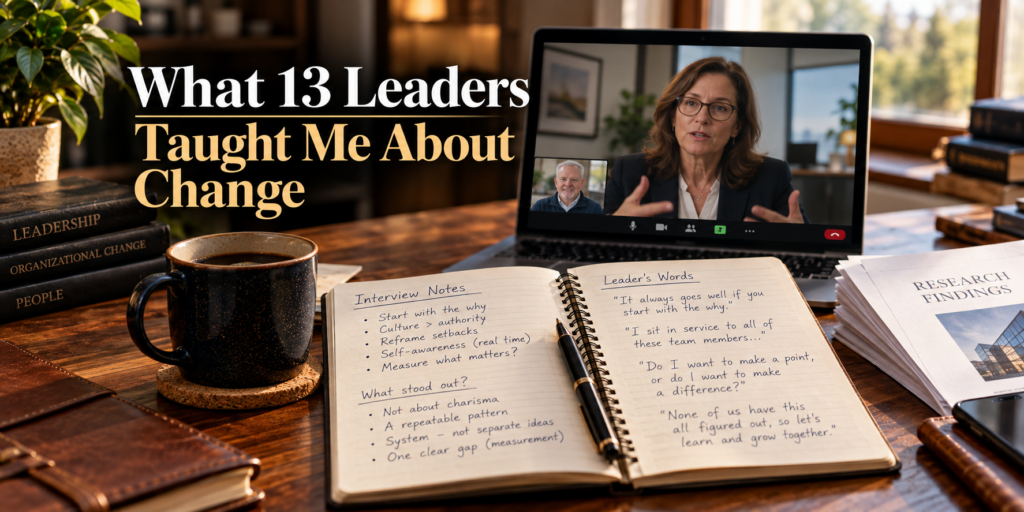
I’ve spent more than two decades leading people through change. Acquisitions, reorganizations, new systems, new leadership, the whole list. Most of it, I’ve gotten right, more by instinct than by any formal system. I’ve always had a good feel for people, and I’ve leaned on that.
But instinct isn’t something you can hand to somebody else. A few years ago I decided I wanted to know something more specific than what had worked for me by feel. I wanted to know whether what I was doing was actually a repeatable pattern, something another leader could learn and use, or just something that happened to work because of how I personally read a room.
So for my doctoral research, I picked a financial services firm going through a period of serious, acquisition-driven hyper-growth. Not a company handed to me as a case study. One I chose because I knew the growth would be brutal enough to expose what leaders were actually doing, not just what they’d say about it in a calmer year.
I sat down with 13 of their senior leaders, from the CEO on down. Then I didn’t just take their word for it. I surveyed 46 of their own direct reports, to check whether what leaders said they were doing actually matched what their people experienced day to day.
Here’s what surprised me first: the leaders who came through this the best weren’t the most naturally gifted communicators in the room, and they weren’t the most charismatic either. What set them apart was a specific, repeatable pattern, one that held together as a system rather than a personality type.
Five patterns showed up, over and over, across leaders who’d never compared notes with each other. They explained the why behind a change, not just the mechanics. They let the organization’s actual culture carry the weight of managing resistance, instead of leaning on authority. They built language and stories that reframed a setback as part of something larger, not proof the plan had failed. And underneath all of it, they were willing to examine their own behavior first, in real time, sometimes out loud, in the room. One leader put it to me this way: “I’ve never looked back on a previous decade in my life and didn’t think I was an idiot the previous decade, and I don’t expect that to change in coming decades. None of us have this all figured out, so let’s learn and grow together.”
Here’s what surprised me more. Even inside an organization doing all of that well, eleven of the thirteen leaders had no formal way of measuring whether any of it was actually working. Not a weak tracking system. No clearly defined targets to track in the first place. Performance outcomes came in as the lowest-scoring measure in the entire study, and not because the leadership was bad. Nothing was inspecting the results.
That’s the part I didn’t expect going in, and it’s the part I think matters most for anyone leading through change right now. Trust and culture can carry an organization a long way. On their own, they’re not enough.
I wrote up the full findings in a paper called Leading Change Well. It walks through all five patterns, the actual words the leaders I interviewed used to describe them, and the one gap that showed up even in an organization doing almost everything else right. If you’re leading people through change of any size, I think you’ll recognize more of yourself in it than you expect.
Read the paper here: https://elevatingexcellence.us/leading-change-well/